


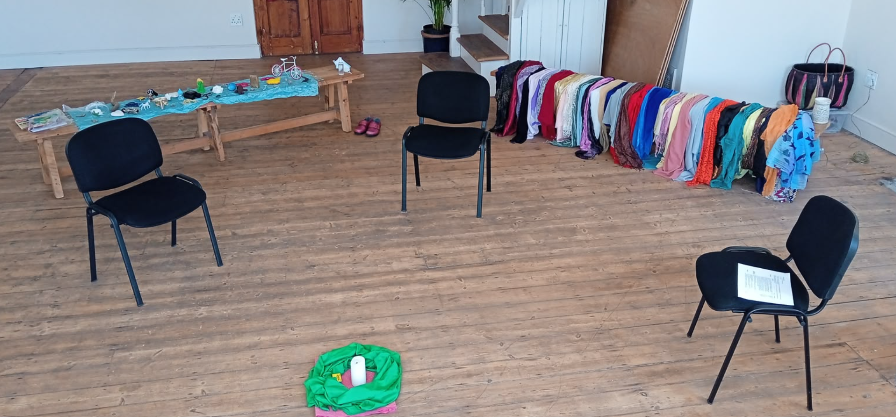
Drama therapy is the intentional and systematic use of drama and theatre processes and products to achieve the psychotherapeutic goals of symptom relief, emotional, cognitive and physical integration and personal growth. Drama therapy incorporates diverse theoretical approaches, action-orientated and experiential in practice, using one or more of the following processes: dramatic play; mime: puppetry: mask work: role play; enactment; ritual; improvisation; storytelling; theatre-making: theatre production; drama games and text. These approaches facilitate the client’s ability to: tell his/her story; solve problems; set goals; gain insight into personal behaviours; practice new behaviours; express feelings appropriately, achieve catharsis; extend the depth and breadth of inner experience; improve interpersonal skilis and relationships; strengthen the ability to perform personal, social and professional life roles while increasing flexibility between these roles.
Drama therapy is practiced with individuals and groups. The structure and distance offered by dramatic text, dramatic play, ritual or traditional stories allows personal experiences to be reviewed in a symbolic, personal and metaphorical way. Role play, observation and experimenting with alternative behaviours and strategies can help to reconstruct difficult group situations and explore alternative group systems, contracts, goals and roles. The process of creating drama has therapeutic value, providing insights and healing that verbal psychotherapy alone may not achieve.
IN MASTER'S LEVEL DRAMA THERAPY TRAINING, A STUDENT MAY BE TRAINED IN OR INTRODUCED TO THE FOLLOWING APPROACHES:
- Bergman Approach
- Developmental Transformations (DVT)
- ENACT method
- EPR approach
- Integrative Five Phase model
- Narradrama
- Omega Transpersonal approach;
- Playback Theatre
- Psychodynamic approach
- Psychodrama
- Role theory and Role method
- Sesame approach to drama and movement therapy
DRAMA THERAPISTS
AMARI BUYS
- HPCSA reg.: AT0001384
- annandaleamari@gmail.com
- Cell: 0725345945
- Port Elizabeth, Eastern Cape
Qualifications:
BIANCA ISAAC
- HPCSA reg.: AT0000884
- noa@noabelling.com
- Cell: 0844751760
- Cape Town, Western Cape
Qualifications:
BOITUMELO MOKOLOPENG
- HPCSA reg.: AT0001783
- dancefixwithvix@gmail.com
- Cell: 0774362482
- Cape Town, Western Cape
Qualifications:
EMILE OWEN RAPOSO
- HPCSA reg.: AT0001643
- emiliedramatherapy@gmail.com
- Cell: 0826125419
- Gauteng, Johannesburg
Qualifications:
EMMA HUTTON
- HPCSA reg.: AT0001597
- emmahttn@gmail.com
- Cell: 0798845399
- Johannesburg, Gauteng
Qualifications:
HAYLEY DOS SANTOS
- HPCSA reg: AT0001783
- info@integrativementalhealth.co.za
- Cell: 0826141874
- Noordhoek, Cape Town
Qualifications:
JESSICA MAYSON
- HPCSA reg: AT0001619
- jessicagrowingspace@gmail.com
- Cell: 0661494125
- Cape Town
Qualifications:
KATYA MENDELSON
- HPCSA reg: AT0002054
- katya.a.m.mendelson@gmail.com
- Cell: 0768948787
- Cape Town, Western Cape
Qualifications:
LESLEY PALMER
- HPCSA reg: AT0001783
- info@intergrativementalhealth.co.za
- Cell: 0826141874
- Noordhoek, Cape Town
Qualifications:
JANÉ NASH
- HPCSA reg.: AT0001384
- connect@janenash.co.za
- Cell: 0651911522
- Honingklip, Krugersdorp, Gauteng
Qualifications:
SAVANAH BRUETON
- HPCSA reg.: AT0002089
- savy.brueton@gmail.com
- Cell: 0711939040
- Online
DANIEYELLA RODIN
- HPCSA reg.: AT0002186
- danieyellarodin@gmail.com
- Cell: 0737966466
- 15 Linden Road, Emmarentia, Johannesburg, Gauteng 2195
Qualifications:
PAULA KINGWILL
- HPCSA reg.: AT0000442
- ednablue@worldonline.co.za
- Cell: 0731692716
- The Rest farm - near Nieu Bethesda, Eastern Cape
Qualifications:
LESLEY PALMER
- HPCSA reg.: AT0000434
- lesley@presenceinaction.co.za
- Cell: 0828285917
- 38 Kenilworth rd, Kenilworth
Qualifications:
NONKULULEKO VILAKAZI
- HPCSA reg.: AT0001848
- nonkuvila@gmail.com
- Johannesburg