
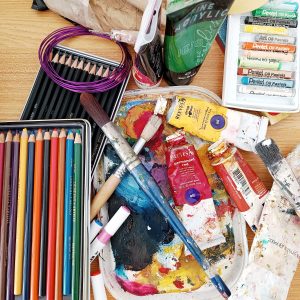
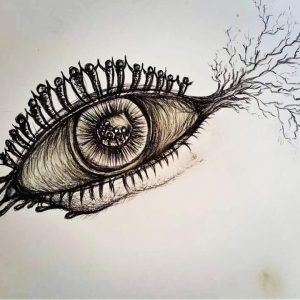
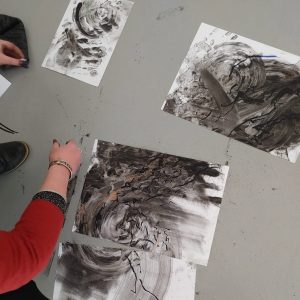
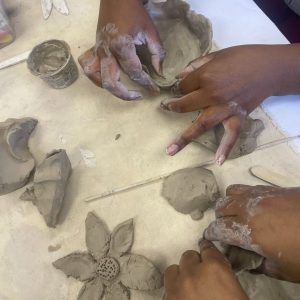


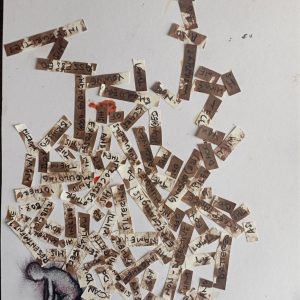
Art therapy (also known as art psychotherapy, analytic art psychotherapy, psychodynamic art psychotherapy and integrative art psychotherapy) is a mode of psychotherapy in which creative use of various physical materials to produce images and objects is integrally part of the therapeutic relationship and process. Art therapy focuses on the making, manipulation and interpretation by client(s) and therapist of visual images, objects and materials (paintings, drawings, constructions etc.) in the presence of the art therapist in a safe setting. The image, object, material process is not considered simply a symptom, but the means through which the subjective and objective nature of the client’s experience is connected, mediated, explored, integrated, and clinically informed. Material engagement leads to self-expression that is processed both verbally and non-verbally.
In general, art therapy aims to restore or enhance the client’s functional competence and emotional balance in a way appropriate to their life context. Art therapy is effective for individual, group and family work, may be directive or non-directive, and ranges from short term interventions to long term therapy. Art therapy is context-sensitive and aims to be appropriate to local conditions as far as possible. Art therapy practice is constantly evolving to reflect the cultural and social diversity of the people who engage in it.
Art therapy practice requires knowledge and understanding of visual art (painting, drawing, sgiipture, and other art forms) and the creative process, as well as human development, psychological and counselling theories and techniques. In addition to psychotherapy theories, art therapists are informed by theories of attachment and systems, as well as neuroscience research and they may integrate a broad range of approaches such as: psycho-education; mindfulness; mindfulness-based stress reduction (MBSR); mentalization-based treatments; compassion-focused, sensorimotor psychotherapy: cognitive behavioural and cognitive analytic therapy; dialectical behaviour therapy (DBT); trauma focused therapy; eye movement desensitization and reprocessing (EMDR) into their practice.
ART THERAPISTS
ALISA RAY
- Registration number: AT0001996
- rayalisa@yahoo.com
- WhatsApp: 0827236065
- Johannesburg, Gauteng
Qualifications:
BA Honours Art Therapy UJ
MA Art Therapy UJ
ANGELA RACKSHAW
- HPCSA reg.: AT000221
- angrack01@gmail.com
- Cell: 0825516233
- Cape Town, Western Cape
Qualifications:
Psychological First Aid (John Hopkins University); PG Dip Art Therapy 1996, Reg Nurse and Midwife and Animal Assisted Therapy
GILLIAN LASKER LAURENCO
- Gillian.lourenco@gmail.com
- WhatsApp: 0767957828
- Cape Town, Western Province
Qualifications:
BA Honours Archaeology UCT
BA Honours Art Therapy UJ
MA Art Therapy UJ
JULIE GURNELL
- Arttherapy@mweb.co.za
- Contact: 0714696623
- Cape Town, Western Province
Qualifications:
KAMAL NARAN
- HPCSA reg.: AT000221
- info@kamalnaranarttherapy.co.za
- Cell: 0724906436
- Glenhazel, Johannesburg, Gauteng
Qualifications:
KATE DODD
- Registration number: AT 0001147
- kateleighdodd@gmail.com
- Contact: 0798018567
- Johannesburg, Gauteng (online sessions available)
Qualifications:
KRISTIE NEL
- Registration number: AT0001503
- kirstienel@gmail.com
- Contact: 0615026750
- Cape Town, Western Cape (online sessions available)
Qualifications:
Psychological First Aid (PFA)(Johns Hopkins University, Online)
MICHELLE BOOTH
- HPCSA reg.: AT0000892
- michelle@michellebooth.co.za
- Cell: 0848064775
- Knysna, Western Cape
Qualifications:
NATALY WOOLLETT
- HPCSA reg.: AT0001023
- woollettn@gmail.com
- Cell: 0766380564
- Johannesburg, Gauteng
Qualifications:
SAMANTHA DAVIS
- Registration number: AT0000469
- info@arttherapy.co.za
- Contact: 0833266655
- Cape Town, Western Cape
Qualifications:
TESSA WHYATT
- HPCSA reg.: AT000221
- tessawhyatt@gmail.com
- Cell: 0849805319
- Cape Town, Western Cape
Qualifications:
DR. NATALY WOOLLETT
- HPCSA reg.: AT0001023
- Woollettn@gmail.com
- Cell: 0766380564
- Johannesburg
Qualifications:
ELSE ROOS
- HPCSA reg.: AT0002275
- info@sacredstudios.co.za
- Cell: 0615429133
- Honingklip, Krugersdorp, Gauteng
Qualifications:
SAXON KINNEAR
- HPCSA reg.: AT0002178
- saxonkinnear@icloud.com
- Cell: 0722459371
- 27 Derry Street, Vredehoek, Cape Town
Qualifications:
MADRI JANSEN VAN RENSBURG
- HPCSA reg.: AT0002267
- madrijvr@gmail.com
- Cell: 0790531024
- KwaDukuza, KZN
Qualifications:
KAMAL NARAN
- HPCSA reg.: AT0001910
- kamal.naran01@gmail.com
- Cell: 0724906436
- Glenhazel, Johannesburg, Gauteng
Qualifications:
KARA SCHOENMAN
- HPCSA reg.: AT0002194
- karaschoeman@gmail.com
- Cell: 0638722141
- Clarens, Free State
Qualifications:
Claire Woollatt
- HPCSA reg.: AT0002151
- claire@hambonathi.co.za
- Cell: 0686498120
- Olivedale, Johannesburg, Gauteng